
Reflections on 10/10/25
A reminder that survival — not speculation — is the only real alpha.


“Smart people go broke three ways: liquor, ladies, and leverage.” — Charlie Munger
Charlie Munger (R.I.P.), Warren Buffett’s legendary business partner, was always warning about the dangers of taking on too much leverage. Last Friday proved it in the most magnified (crypto-style) way possible.
On October 10, 2025, the cryptocurrency market experienced its largest liquidation event in history: $19.3 billion wiped out in 24 hours. $BTC plummeted from peaks above $123,000 to lows near $102,000, a 14-16.5% drop. $ETH went down over 11%. Altcoins suffered catastrophic losses, $HYPE down 54%, $SUI down 30%, $SOL down 26%, just to mention some that I keep a closer look at. Some other tokens crashed up to 90% before partial recovery, and millions of traders were liquidated in the biggest crypto meltdown ever.
The apparent spark was President Trump’s announcement of 100% tariffs on Chinese imports — but calling it the cause would oversimplify the chain of events. Markets were already stretched by high levels of leverage, thin liquidity, and extreme positioning. The tariffs probably acted more like a match dropped into a room filled with gas — they triggered something that was structurally bound to explode sooner or later.
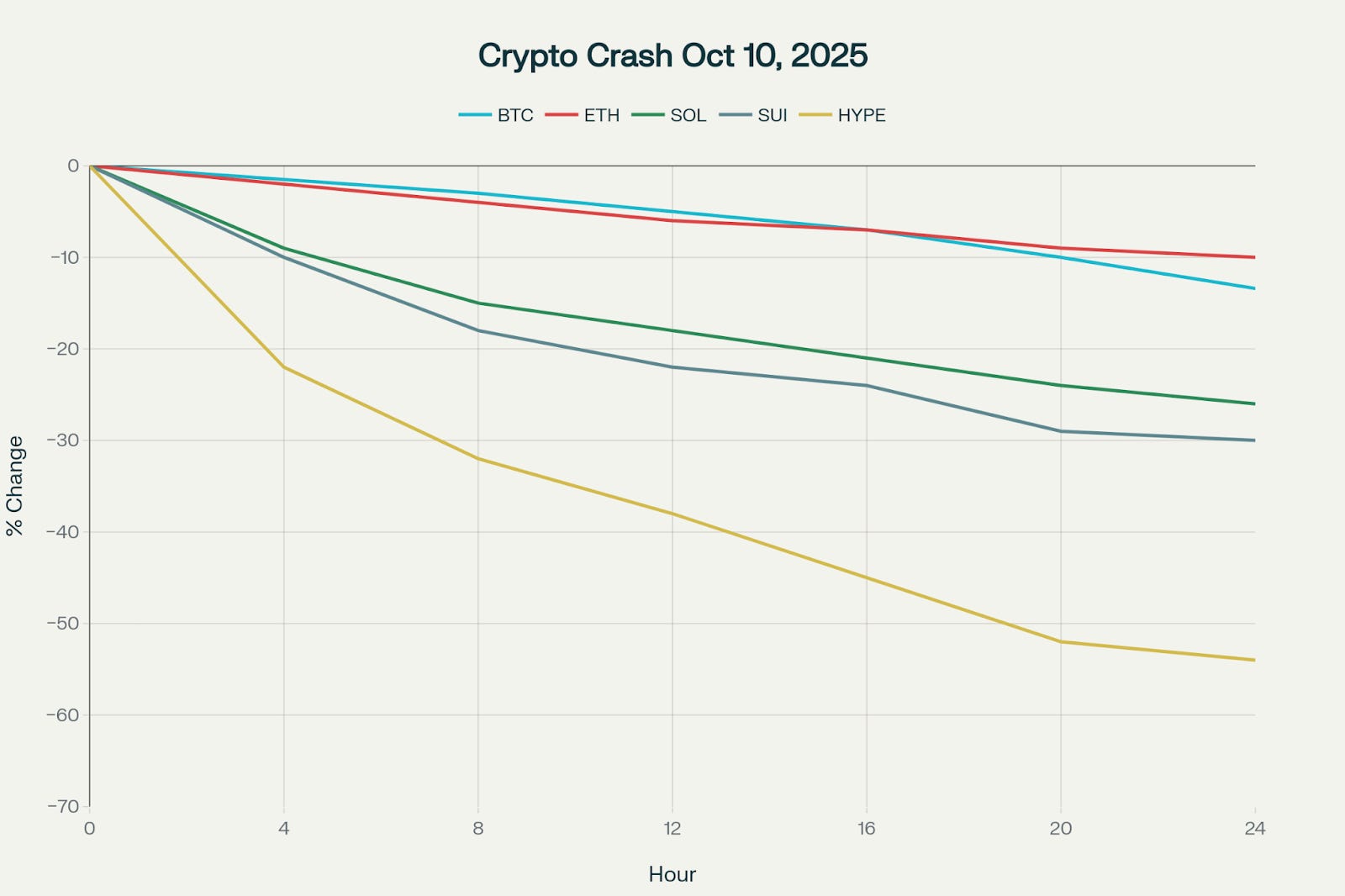
Despite Bitcoin’s recent all-time high, crypto still remains under-capitalized relative to traditional markets, resulting in structurally higher volatility. Before the October 10 crash, we saw digital assets surpass a $4 trillion market cap (definitely not a small number), yet massive liquidity fragmentation across an ever-growing number of new assets tends to amplify movements during stress events, reaching levels few TradFi analysts would anticipate.
Several structural factors created the perfect storm: extreme market fragmentation, excessive speculation, unprecedented leverage, and minimal regulatory oversight. Let’s examine each with data.
The Fragmentation Problem: Why Size Doesn’t Equal Stability
Crypto vs. Traditional Markets: Numbers
At first glance, crypto looks substantial in absolute terms, it is already a multi-trillion market:
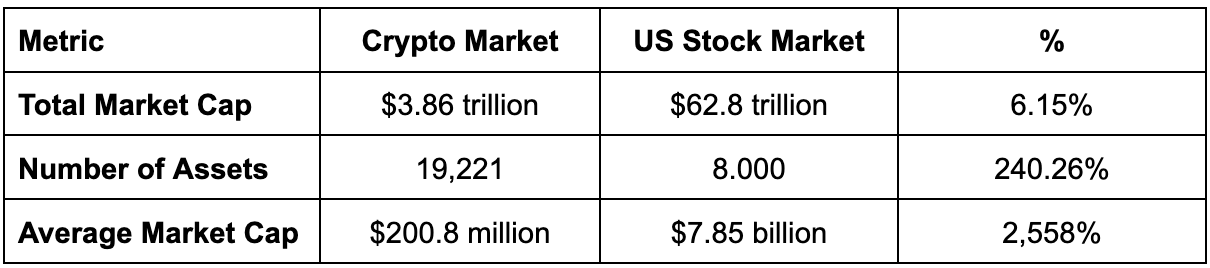
It is very fragmented though. When you have $3.86 trillion spread across 19,221 tokens, you create thousands of shallow liquidity pools. Worth to mention also that $BTC and $ETH alone represent 70% of the whole crypto market cap, magnifying the fragmentation problem even more.
During normal conditions, this fragmentation might not be very meaningful, excepting for the potential slippage while executing larger orders in less liquid venues. During stress events though, it becomes catastrophic. Small sell pressure in these shallow pools triggers liquidations, cascading across the entire ecosystem.
The Turnover Paradox: Speculation at Scale
Despite being only 6.15% the size of the US stock market, crypto shows dramatically higher trading velocity. According to Crypto.com Research (”Wall Street On-Chain Part 3: Trading & Liquidity,” Oct 2025), crypto turnover ratio of 1.606% versus 1.043% for stocks, a 53% difference.
This showcases something empirically known and critical: crypto markets aren’t just smaller and more fragmented, they’re fundamentally more speculative. A higher percentage of the total market cap changes hands every day, indicating massive trading velocity across dozens of exchanges globally, with traders moving between thousands of token pairs, often with significant leverage.
High turnover + shallow liquidity + massive leverage = extreme volatility during stress events.
Leverage: The Amplification Engine
This brings us to leverage, the accelerant that in my opinion turned October 10’s sell-off into a historic wipeout. Some crypto exchanges offer up to 125x leverage, something unthinkable in traditional markets.
This isn’t an accident. CEX and DEX platforms derive significant revenue from futures and derivatives products. During the October 10 crash, futures volume dominated spot trading as usual, creating perverse incentives: exchanges profit when traders use high leverage, even though high leverage is precisely what can destroy retail capital during volatility.
The Cascade Effect
Digital assets are still extremely correlated to Bitcoin. When $BTC dropped over 15% in just a few hours, the leverage cascade was brutal:
Total liquidations: $19.3 billion in 24 hours
Traders liquidated: 1.6 million
Market cap erased: $400-500 billion
Scale: Nearly double the Terra Luna crash in May 2022 and 16 times larger than the March 2020 COVID crash.
Each liquidation became new selling pressure, triggering more liquidations. Traders using up to 100x leverage were completely wiped out instantly.
Regulatory Gaps: Why This Was Possible
Cryptocurrency markets operate in a regulatory vacuum compared to traditional finance:
No circuit breakers like those that halt stock trading during extreme moves
24/7 trading without the natural cooling-off periods that stock markets provide
Minimal oversight of market makers and large liquidity providers
Progress in 2025
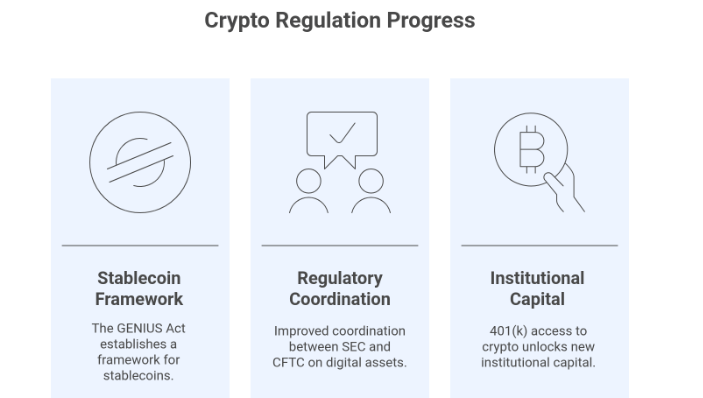
The US is moving toward clearer crypto regulation (and with them, the rest of the world is taking a ride):
The GENIUS Act provides a stablecoin framework
SEC and CFTC coordination on digital asset oversight has improved
401(k) access to crypto is unlocking new institutional capital
However, none of these advances changed the practical outcome of the episode, which many smart observers argue may have been amplified by large short positions taken before the announcements — a pattern some consider indicative of potential insider trading.
Friday’s Timeline: What Actually Happened
On October 10, 2025, Trump announced 100% tariffs on all Chinese imports, effective November 1, 2025. This was a massive escalation from existing 30% tariffs, bringing total duties to 130%. The announcement followed China’s export restrictions on rare earth minerals critical for semiconductor and EV production.
The Temporal Gap
The sequence of events on October 10 paints a troubling picture.
Shortly before the public announcement of new U.S. tariffs on China, unusually large leveraged short positions were opened on Hyperliquid targeting both BTC and ETH. When the news broke, crypto markets initially moved in line with traditional markets — a typical risk-off reaction to macro uncertainty.
What followed, however, went far beyond normal volatility. As the sell-off deepened, altcoin liquidations began accelerating sharply across exchanges. Then came a critical decoupling event: assets like USDe, wBETH, and BNSOL suddenly crashed on Binance alone, reportedly due to an oracle malfunction. That localized failure rippled through the system, triggering a cascade of forced liquidations and a full-blown market structure collapse.
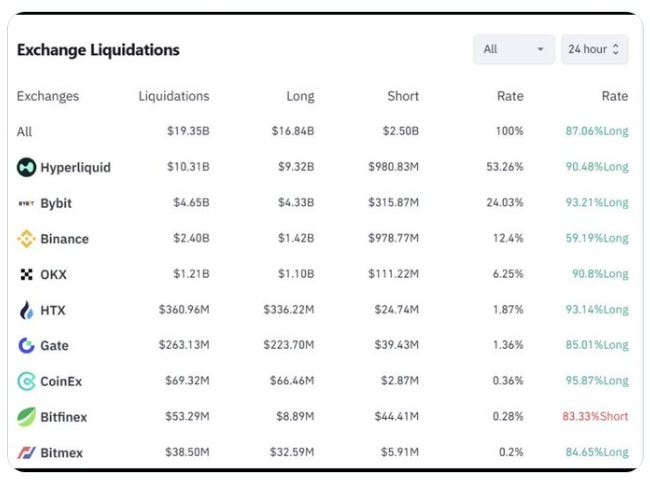
The Hyperliquid trader banked $ 192 million in profits from his trade.
The delay between Trump’s announcement and the crash’s acceleration suggests the tariffs alone cannot explain the magnitude of what followed. It’s more likely that existing fragilities — high leverage, cross-exchange liquidity fragmentation, and correlated altcoin exposure — amplified an otherwise normal macro shock into a system-wide liquidation cascade.
The crypto community is divided. Was it excessive leverage finally unwinding? The tariff announcement triggering macro fear? A Binance oracle error? Massive coordinated insider trading? The truth is, we’ll only know with time and potentially investigation.
What we can analyze for now are the structural factors inherent to the crypto market — particularly among altcoins — discussed earlier in this piece, which amplified whatever the initial trigger might have been.
Another noteworthy takeaway is that, even with the massive liquidation volume on Hyperliquid over such a short window ($10 billion from the total of $ 19 billion), the exchange held up flawlessly — no downtime, no glitches. Meanwhile, many users struggled to execute trades on centralized exchanges amid the chaos.
Market Psychology: History Repeating Itself
Charles Mackay’s Prescient Observations (1841)
In “Extraordinary Popular Delusions and the Madness of Crowds,” Charles Mackay wrote:
“Men, it has been well said, think in herds; it will be seen that they go mad in herds, while they only recover their senses slowly, one by one.”
And:
“We find that whole communities suddenly fix their minds upon one object, and go mad in its pursuit; that millions of people become simultaneously impressed with one delusion, and run after it, till their attention is caught by some new folly more captivating than the first.”
Nearly 200 years later, Mackay’s observations about crowd psychology perfectly describe crypto’s volatility patterns. Markets driven by speculation and crowd behavior inevitably overshoot in both directions, crashing below fair value during panic, rallying above it during euphoria.
Market Concentration: Systemic Vulnerability
There’s another critical factor: market concentration amplifies systemic risk.
More numbers: several sources suggest that Binance concentrates over 50% of total crypto trading volume and top 10 exchanges represent 85-90% of the market.
When big whales and massive liquidity providers pull liquidity from concentrated platforms like Binance, entire markets can collapse. There’s no distributed network of liquidity providers to absorb shock. Instead, you have centralized chokepoints where the withdrawal of a single large player cascades across the entire ecosystem.
This is the opposite of crypto’s decentralization ethos, yet it’s the reality of how markets function today.
Lessons: What October 10 Teaches Us?
Warren Buffett’s most famous rules:
“Rule No. 1 is never lose money. Rule No. 2 is never forget Rule No. 1.”
Staying alive, protecting capital and generating consistent gains in the long run is far more important for building wealth than striking massive performances once in a while. In the end, longevity compounds more than luck ever will, but you’ve got to stay alive in the game.
The Nuanced View on Leverage
Let me acknowledge something: Buffett’s categorical rejection of leverage may be too harsh. There’s legitimate value in leverage for arbitrage and high-frequency strategies, when executed by professionals with sophisticated risk management policies.
But here’s the critical distinction: these are professional operations with risk controls that retail investors simply don’t have.
For retail participants, the October 10 crash demonstrates why Buffett’s warning stands: leverage is the primary destroyer of wealth in volatile markets.
In this scenario, the clear winners were the exchanges. Just like in Vegas, the house always wins. The losers, however, aren’t limited to retail. When the tide goes out, smaller exchanges, overexposed market makers, and even asset managers can also be caught swimming naked. Risk mismanagement in a 24/7 leveraged market has a delayed but inevitable cost — and if recent history taught us anything, it’s that even the biggest players can implode spectacularly. FTX already gave us that lesson.
The Bottom Line
The October 10, 2025 crypto crash was the biggest black swan event in crypto’s history. It exposed critical weaknesses in the market’s structure: extreme fragmentation across thousands of tokens, excessive leverage amplifying every move, and regulatory gaps that allowed chaos to unfold without safeguards.
This volatility is a feature of an immature market. Despite Bitcoin’s maturation and institutional adoption, crypto remains fundamentally different from traditional finance. Yet I believe this gap will narrow quickly, driven by fast-growing institutional capital influx and evolving regulatory clarity.
Until then, investors should prepare for continued extreme volatility. Markets driven by emotion always swing to extremes, Robert Shiller’s “Irrational Exuberance” showed how collective optimism and pessimism produce persistent deviations from fair value. Crypto showcases his theory on steroids.
But the very same volatility creates massive opportunities for those who manage risk properly and stay alive, and the question now isn’t if another unexpected event will happen. It’s when, and whether you’ll be positioned to survive it.
For that, Buffett’s wisdom remains timeless: the first rule is not to lose money. For most retail investors, that means avoiding the leverage trap that destroyed 1.6 million positions in a single day.